

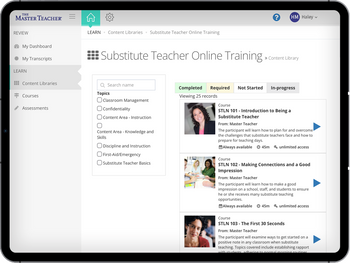
Substitute Teacher Online Training
Give your substitute teachers a strong start with 25 flexible, self-paced courses, each designed to be completed in 90 minutes or less. These courses equip substitutes with practical skills that directly support their work in classrooms and schools.
Topics include:
- Connection and communication with students and staff.
- Classroom management.
- Learning styles and strategies.
- Confidentiality.
- First aid and emergencies.
- Content area instruction in reading, writing, and math.
- Content area knowledge and skills in reading, writing, and math.
Each course includes an automatically graded posttest and a downloadable transcript. Completion records and applicable certificates to track and document training are easily accessible through our eLearning Platform.
In addition to completing an approved substitute training program, most states (including Hawaii and Wisconsin) require candidates seeking substitute certification to also hold an associate's degree or higher from an accredited college or state university.
Call 800.669.9633 for site license pricing or schedule a demo.
Course List
101
Introduction to Being a Substitute Teacher
The participant will:
- Learn how to plan for and overcome the challenges that substitute teachers face.
- Learn how to prepare for teaching days.
102
Making Connections and a Good Impression
The participant will:
- Learn how to make a good impression on staff, students, and the school to ensure they receive many substitute teaching opportunities.
103
The First 30 Seconds
The participant will:
- Examine ways to get started on a positive note in any classroom when substitute teaching.
- Learn about establishing rapport with students, adhering to normal morning routines, and being prepared for the unexpected.
104
Being an Effective Classroom Manager
The participant will:
- Learn how to effectively manage a classroom by keeping students engaged and on task.
105
Communication in the School
The participant will:
- Learn how to communicate with students, faculty, and administrators.
- Learn how to encourage effective classroom discussions among students.
106
Effective Classroom Discipline
The participant will:
- Learn how to set expectations for students and enforce school rules and classroom discipline when substitute teaching.
107
Active Learning
The participant will:
- Study how to construct a lesson that will engage students in active learning.
108
Learning Styles and Strategies
The participant will:
- Study different learning styles students may have including learning modalities, multiple intelligences, and perceptions.
109
Bloodborne Pathogens
The participant will:
- Review the basics of bloodborne pathogens and other biohazards including identification, consequences of contamination, protection, and prevention.
- Review scenarios to consider to respond.
110
Supporting Instruction: Reading
The participant will:
- Review information about reading and literacy programs.
- Learn strategies for helping students with reading.
- Collect tips for making appropriate accommodations and modifications.
111
Supporting Instruction: Writing
The participant will:
- Review the writing process.
- Learn strategies for helping students with writing.
- Gain tips for making appropriate accommodations and modifications to writing activities.
112
Supporting Instruction: Mathematics
The participant will:
- Review information about the fundamentals of math instruction.
- Learn strategies for helping students with problem solving.
- Collect tips for making appropriate accommodations and modifications.
113
Reading Comprehension: Narrative Texts
The participant will be able to:
- Define narrative text.
- Identify and describe the elements of narrative texts.
- Interpret, synthesize, and evaluate a narrative text.
114
Reading Comprehension: Informative Texts
The participant will:
- Review the elements of informative texts.
- Practice identifying informative text elements.
- Review five informative text structures.
- Interpret and evaluate informative text structures.
115
Reading Comprehension: Decoding Language and Utilizing Layout
The participant will:
- Review three basic strategies for decoding unfamiliar words.
- Review the parts of words that aid in decoding unfamiliar words.
- Practice using the strategies to decode unfamiliar words.
- Review figurative language.
- Practice identifying types of figurative language.
- Review the informational layout of books.
- Practice identifying specific parts of a book.
116
Writing Fundamentals: Parts of Speech and Effective Sentences
The participant will:
- Review the function and types of nouns, pronouns, verbs, adjectives, adverbs, prepositions,
conjunctions, and interjections. - Practice identifying the eight major parts of speech.
- Review the parts of a complete sentence.
- Review the forms that sentences can take.
- Review the purpose of different sentence types.
- Review the common mistakes made in writing sentences.
- Practice identifying the parts of a sentence and common errors in writing.
117
Writing Fundamentals: Mechanics of Writing
The participant will:
- Review the rules for capitalization.
- Practice identifying the proper capitalization in sentences.
- Review the major punctuation marks.
- Review the rules for using punctuation.
- Practice identifying the appropriate punctuation.
- Review the basic spelling rules for commonly misspelled words.
- Practice identifying spelling errors.
118
Mathematics: Understanding the Basic Skills
The participant will:
- Review basic mathematical concepts.
- Review basic mathematical terminology such as sum, difference, product, quotient, dividend, and divisor.
- Review the basic mathematical operations of whole numbers.
- Review the proper order for mathematical operations.
- Recognize and interpret mathematical symbols.
119
Mathematics: Fractions, Decimals, and Percentages
The participant will be able to:
- Identify and describe the components of fractions, improper fractions, mixed numbers, decimals, and percentages.
- Perform basic mathematical operations of fractions, decimals, and percentages to include addition, subtraction, multiplication, division, and conversion.
120
Basic Algebra
The participant will:
- Review algebra terms, exponents, and methods for solving basic equations.
- Practice evaluating simple algebraic expressions.
121
Basic Geometry
The participant will be able to:
- Define basic geometric terminology.
- Identify basic geometric figures.
- Practice the formulas for computing perimeter, area, and volume for basic geometric shapes.
- Plot ordered pairs on a coordinate grid.
122
Mathematics: Data Analysis
The participant will be able to:
- Define key statistical terminology.
- Find the range, mean, median, and mode of data sets.
- Interpret bar and circle graphs.
123
Introduction to Emergency Action Principles
The participant will:
- Understand the importance of learning first aid and preventing disease transmission.
- Learn how to prevent, prepare, and respond to emergencies.
124
Providing Care in an Emergency
The participant will be able to:
- Demonstrate how to respond and provide care in the event of an emergency or sudden illness.
- Describe how to evaluate and treat wounds, control bleeding, and help burn victims.
- Explain the basics of evaluating and treating musculoskeletal injuries.
- Discuss how to help victims of sudden illnesses, including seizures, diabetic emergencies, poisoning, allergic reactions, and heat- and cold-related illnesses.
125
Confidentiality
The participant will:
- Review the legal basis of maintaining confidentiality for students served by special education.
- Discuss who has access to certain types of student information.
- Learn how to answer questions from others involving confidential information.

Bundle Any of Our eLearning Libraries
- Cloud-based, accessible on tablets and mobile devices
- Single sign-on with Google or Microsoft
- Easily manage users and track all Pd hours within one system
- Require courses, set due dates, and monitor course programs, competition, and credits
- Generate official documentation with user-friendly transcripts
- Easily export eLearning reports in Excel, CSV, or PDF formats

